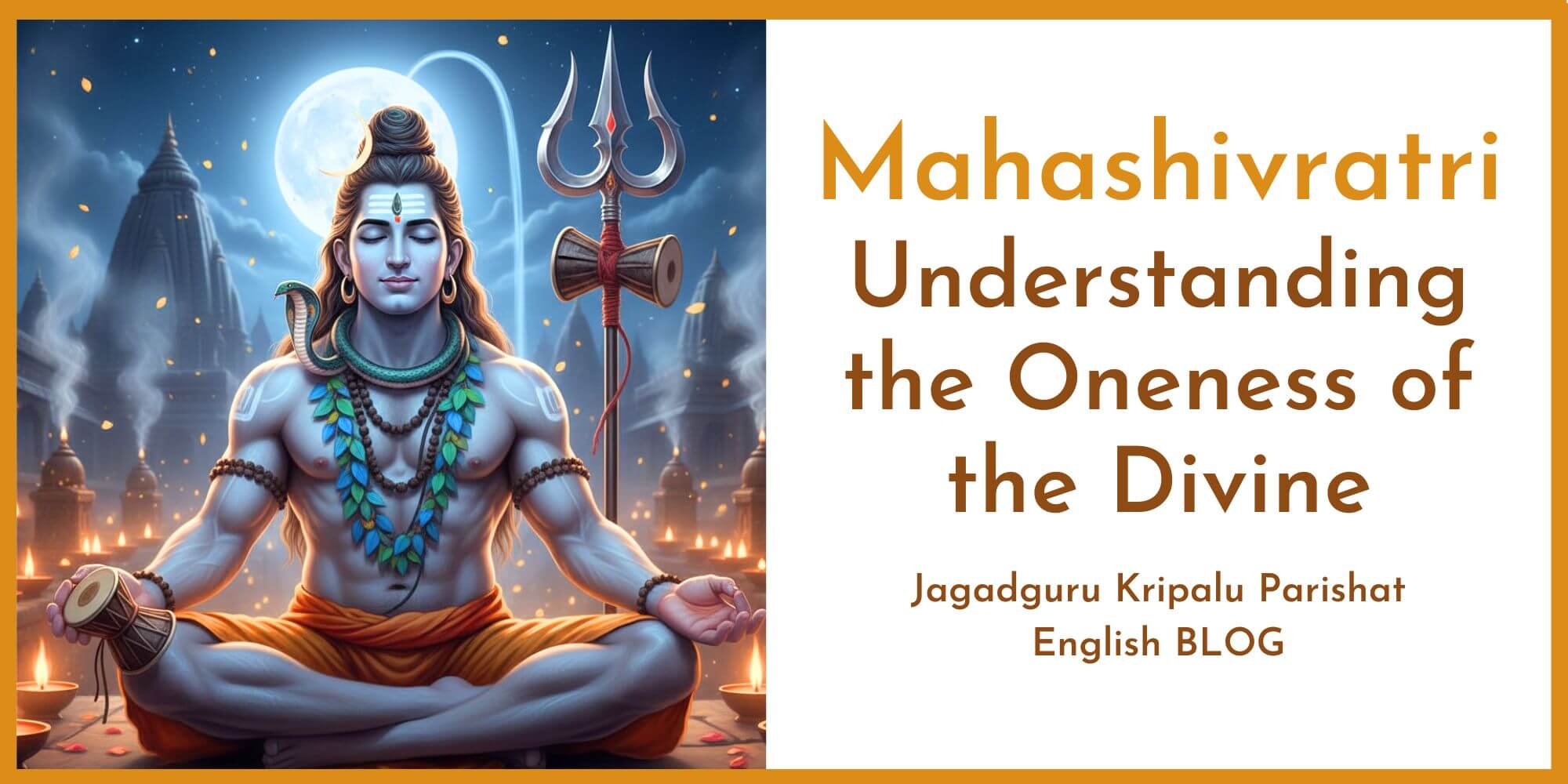
Mahashivratri -Understanding the Oneness of the Divine
By Jagadguru Shri Kripalu Ji Maharaj
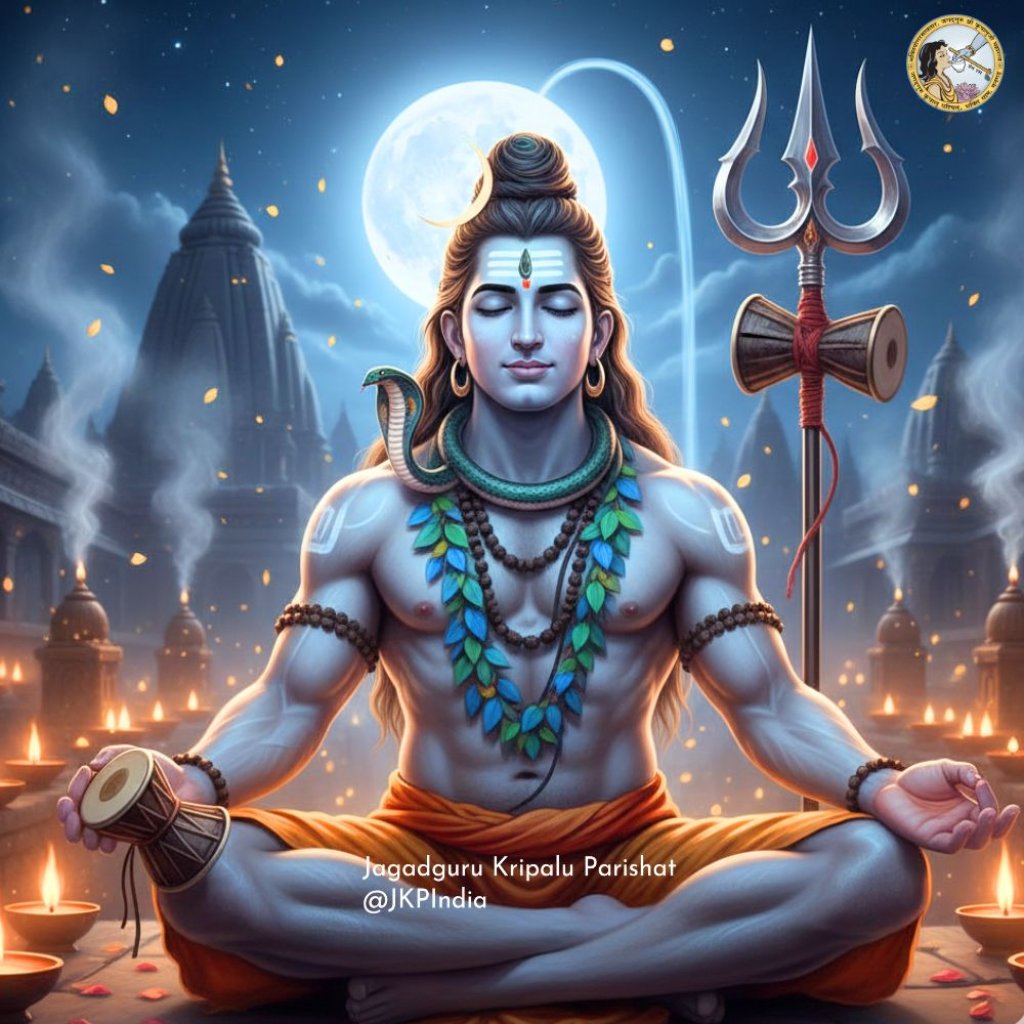
On the sacred night of Mahashivratri, millions bow before Bhagwan Shankar – the great ascetic, the compassionate Lord of Yogis, the silent witness of the cosmos. Temples resound with “Har Har Mahadev,” lamps are lit, and hearts turn inward in prayer.
Yet beyond the rituals and observances lies a deeper truth that this holy night invites us to understand: Who is Shankar? What is His relationship with Shri Krishna? And how should a sincere seeker approach Him? Mahashivratri is not merely a celebration of Lord Shiva – it is an opportunity to realize the profound unity of the Divine.
A seeker once asked: In the Ramayan we find statements such as, “Without worship of Shiv Shankar, no devotee can attain My grace.”
When a reader encounters such verses, a question naturally arises:
Is it compulsory to worship Shankar Ji in order to attain Krishna or Ram?
The answer is no.
Devotion should be practiced according to one’s own spiritual inclination, accepting one’s chosen deity (Isht Dev). Worship Ram. Worship Krishna. Worship whichever form of God that draws your heart. But do so along with devotion to your Guru.
As has been explained many times: devotion to Guru and Bhagwan alone is to be practiced.
These verses were written in a particular historical context. During the time of Goswami Tulsidas, there was significant sectarian conflict between the holy men – Shaivites and Vaishnavas in North and South India. Followers of one tradition began criticizing the other. Arguments arose. Quarrels escalated. Even hostility and violence occurred in the name of devotion.
So Shankar Ji inspired Tulsidas to write in the Ramayan in such a way that people would not develop ill feelings toward Him. At that time, some people had begun speaking negatively about Shankar Ji – saying that He is mad, that He eats datura and madara, that He consumed poison, that He lives among ghosts, that He remains unclothed and they began portraying these divine qualities as faults.
“Nimna-gānām yathā Gaṅgā, devānām Acyuto yathā,
Vaiṣṇavānām yathā Śambhuḥ, purāṇānām idam tathā.”
Meaning:
Just as among rivers the Ganga is supreme, among worshipable chosen deities, Shri Krishna is the sweetest of all and among devotees, Shankar Ji is the greatest. (He is a devotee of Shri Krishna. He even went to participate in the Maharas). Among the Puranas, the Bhagavatam is supreme.
In other words, Lord Shankar is declared in the Bhagavatam to be the greatest among devotees.
Shankar Ji, in fact, is a swansh expansion.
Shri Krishna has two types of expansions (ansh):
- Swansh – personal expansions
- Vibhinnansh – separated expansions
Within the category of vibhinnansh, there are two divisions – two types of souls (jivas):
- The eternal associates of God – forever liberated from Maya.
They are Bhagwan’s divine attendants (parshads), eternally residing in His abode. - Those bound by Maya since beginningless time – like all of us.
These are the separated expansions who have been under the influence of Maya from eternity.
The separated expansions (vibhinnansh) are manifestations of God’s Jeev Shakti – the individual soul energy. However, the Swansh forms are direct personal expansions of God Himself. In other words, they are Bhagwan Himself.
Bhagwan Shankar is such a Swansh manifestation.
Therefore Tulsidas wrote in the Ramayan:
“Shankar jagat bandye Jagadisha,
Sur nar muni sab navat shisha.”
Meaning: The whole world worships Shankar as Jagadish; gods, humans, and sages all bow their heads before Him.
Jagadish means the Lord of the universe – the one source from whom creation arises. That supreme Lord is one alone.
Thus, Shankar Ji is a non-different manifestation of the Supreme Lord. Don’t think that a swansh is something small or inferior to god. He governs the Svaroop Shakti – the intrinsic divine potency.
All great personalities who are Vibhinnansh are governed through that divine potency (Svaroop Shakti). Souls liberated from Maya from eternal times are also governed through it. But Swansh forms themselves preside over that power – therefore they are called Bhagwan.
All Swansh forms are Bhagwan. God has infinite forms. Among them, one form is Shankar Ji.
Shankar Ji and Parvati have also taken incarnation many times. In every Dwapar Yuga appears the Radha-Krishna Yuga Avatar. There are divine narrations describing how Shankar and Parvati manifested as Radha and Krishna in certain incarnations.
Once, Parvati said, “Let us both become Shri Krishna.” Since she is dark in complexion as Kali Devi, she became Shri Krishna. Shankar Ji is fair, so he became Radha. Taking an incarnation, they descended to this mortal world in the forms of Radha and Krishna.
Thus, all forms of Bhagwan are mutually one. In some places, Shri Krishna is shown worshipping Shankar Ji; in other places, Ram Ji establishes and worships Shankar Ji at Rameshwaram. Elsewhere, Shankar Ji is shown as a devotee of Ram.
All of this reflects the same Divine Reality. These are not two separate beings. All forms are one – completely non-different.
This subject is vast and profound. There is no need to go deeply into its metaphysical intricacies. Simply understand this:
You are not required to worship every incarnation.
If you worship Radha-Krishna, it is not compulsory that you must also worship Sita-Ram, Kachhapa Avatar, Varaha Avatar, Parashuram Avatar, and every other incarnation.
Worship Radha Krishna. Worship your Guru.
As for all other forms of Bhagwan – offer respectful pranam, recognizing them as divine manifestations.
Form meditation (roop-dhyan) and spiritual practice (sadhana) should be centered on Hari and Guru alone.
But there must never be ill-feeling toward any form of God.
If you harbor disrespect toward Shankar Ji, how will Shri Krishna be pleased? Shankar Ji is extremely dear to Him. And Shri Krishna is extremely dear to Shankar Ji.
There is no requirement to meditate upon the form of any avatar. You just have to meditate upon the form of your chosen deity alone. Follow the teachings of your Guru faithfully, and offer respectful obeisance to all divine forms.
This is the true spirit of Mahashivratri – understanding the oneness of the Divine.
From a discourse by Jagadguru Shri Kripalu Ji Maharaj
A brief introduction of Jagadguru Shri Kripalu Ji Maharaj*
(Known by His devotees as Shri Maharaj Ji)
The original title of Jagadguruttam (Greatest Spiritual Teacher of the World) was bestowed upon Shri Kripalu Ji Maharaj on January 14, 1957, by Kashi Vidvat Parishad (a council of 500 greatest scholars saints of India). He composed divine texts like Prem Ras Madira, Prem Ras Siddhant, and Radha Govind Geet to lead us on the right path of devotion. He also gave priceless monuments as gifts to the world which include Bhakti Mandir located in Bhakti Dham, Mangarh, Prem Mandir located in Vrindavan Dham, and Kirti Mandir located in Barsana Dham. Shri Maharaj Ji also built hospitals for the impoverished, the Jagadguru Kripalu Chikitsalaya in Vrindavan, Jagadguru Kripalu Chikitsalaya in Barsana, and another one in Pratapgarh. All three help millions of underprivileged to gain free access to medical care. His Kindergarten, School, and College for impoverished girls Jagadguru Kripalu Parishat Education is located in Kunda and provides completely free education. To stay updated with all the news and events of Jagadguru Kripalu Parishat, visit www.jkp.org.in/jkpwhatsapp.
Follow us on Social
Recent Posts
Ram in Krishna, Krishna in Ram
28 March 2026
The True Spiritual Significance of Holi
5 March 2026
Gaurang Mahaprabhu: The Incarnation of Divine Love
5 March 2026
Mahashivratri -Understanding the Oneness of the Divine
14 February 2026
Beyond Valentine’s Day: The Divine Love of Gopi Prem
14 February 2026
Jagadguruttam’s Teachings: How to Practice Bhakti for Shri...
17 January 2026

Jagadguruttam’s Teachings: Where is True Happiness?
17 January 2026
Jagadguruttam’s Teachings: WHO AM I?
17 January 2026
The New Year: A Time for Reflection
2 January 2026

Tulsi and Shaligram Vivah
2 November 2025
Akshay Navami: Remembering Radha Rani’s Lotus Feet
31 October 2025
Gopashtami: When God Became a Cowherd
29 October 2025
The Story Behind the Worship of Giriraj Govardhan
22 October 2025
Sharad Purnima Special – Always Feel the Presence of G...
5 October 2025
10th Anniversary of Jagadguru Kripalu Chikitsalaya, Vrindava...
26 September 2025
Janmashatami Special – Why connect with Shri Krishna?
11 August 2025
Janmashatami Special – Who is Shri Krishna?
5 August 2025
Who is More Merciful – God or the Saint?
11 July 2025
Who is Lord Jagannath?
27 June 2025
True Yoga: A Union of Body, Mind and Soul
22 June 2025
Celebrating Father’s Day with God
13 June 2025
Shri Radha Rani – Our Eternal Mother
10 May 2025
Sita is Ram, Ram is Sita
5 May 2025
Hanuman Ji’s Unmatched Seva
12 April 2025
Beyond Colors: Prahlad’s Teachings & the Spiritual Si...
15 March 2025
Beyond Colours: Prahlad’s Teachings & the Spiritual S...
14 March 2025
Who is Gaurang Mahaprabhu?
13 March 2025
What Blessing Should One Ask from Bhagwan Shiva?
24 February 2025
Celebrating 13 Glorious Years of Prem Mandir
22 February 2025
Gopi Prem Day – A Celebration of Divine Love
14 February 2025

Where does the soul go after death?
26 January 2025
The Relationship between God and the Soul – (The Real ...
21 January 2025
The Relationship between God and the Soul (The True Meaning ...
18 January 2025
The Relationship between God and the Soul
3 January 2025
Celebration or Contemplation on New Year
31 December 2024
The Unconditional Grace of God and Mahapurush
22 December 2024
Spiritual Leaders of Vrindavan Unite in Unprecedented Suppor...
10 December 2024
An Icon of Selfless Service: Remembering Her Holiness Sushri...
30 November 2024
A Soulful Tribute from the Preachers of Jagadguru Shri Kripa...
30 November 2024
The Story Behind Tulsi Vivah
11 November 2024
The Significance of Akshay Navami
10 November 2024
Bhaiya Dooj Celebrations
3 November 2024
Govardhan Pooja
2 November 2024
The secret behind celebrating Dhanteras
26 October 2024
Essence of Karwa Chauth
19 October 2024
Sharat Purnima, The Crest Jewel of all Festivals
18 October 2024
What is Roopdhyan by Jagadguru Shri Kripalu Ji Maharaj
12 October 2024
How do we control our Anger?
26 September 2024
Shri Radha Rani: The Essence of Divine Love
5 September 2024
The Divine Prison of Shri Krishna
31 August 2024
How to Build a Personal Relationship with Lord Krishna
25 August 2024
How to celebrate Raksha Bandhan
19 August 2024
The Significance of Hariyali Teej
7 August 2024
Rama Naam Satya Hai
5 August 2024
How to Engage Your Mind in God
5 August 2024
The importance of a Guru in a devotee’s life
15 July 2024

True meaning of ‘Yoga’ (Yog)
21 June 2024
Shri Krishna, Our Real Father
15 June 2024


How to control the mind?
2 June 2024

True Happiness
2 June 2024

How Fortunate You Are
31 May 2024
Narasimha Jayanti
19 May 2024
Importance of Sita Navami
15 May 2024
Importance of Mother’s Day
13 May 2024
The Significance of Akshaya Tritiya
9 May 2024
Lord Ram is our only True Relative
3 April 2024
Shri Guru Dham, Bhakti Mandir – A Divine Resolve
27 March 2024
The Festival Holi
25 March 2024
Bhakti of Lord Shankar Ji
7 March 2024
12th Anniversary of Prem Mandir
6 March 2024
Gopi Prem
13 February 2024
A Tale of Shabari
22 January 2024
Guru Dispels Darkness
14 January 2024
GOD and GURU
14 January 2024
Jagadguruttam Shri Kripalu Ji Maharaj
14 January 2024
New Year Message by Jagadguru Shri Kripalu JI Maharaj
30 December 2023
The Supremacy of Divine Name ‘RADHE’
30 December 2023
Akshay Navami
21 November 2023
Significance of Govardhan Pooja
13 November 2023
The Significance of Diwali
9 November 2023
Meaning of Karwa Chauth
31 October 2023
Sharat Purnima has come once again…
27 October 2023
Sharat Purnima
27 October 2023

How to find true peace and happiness?
13 October 2023
What is my relationship with God?
13 October 2023
Who is Shri Radha?
21 September 2023
The Supremacy of the Divine Name, ‘RADHE’
19 September 2023
What is our relationship with Shri Krishna? Part 3
28 August 2023
What is our relationship with Shri Krishna? Part 2
28 August 2023
What is our relationship with Shri Krishna? Part 1
28 August 2023
The Significance of Naag Panchami
21 August 2023
The Profound Significance of Guru Purnima
30 June 2023
THE GURU
30 June 2023
Why do we have mood swings?
28 May 2023
Discovering the True Mother on Mother’s Day
12 May 2023
How do we become more tolerant?
4 January 2023
What is the root cause of poor Mental Health?
16 December 2022

How to Improve your Mental Health in 3 simple steps
9 December 2022
How to end suffering and increase our Atman Shakti?
8 December 2022