Guru Purnima Special: What is Guru Tattva?
(Excerpt of a speech delivered by Jagadguru Shri Kripalu Ji Maharaj)
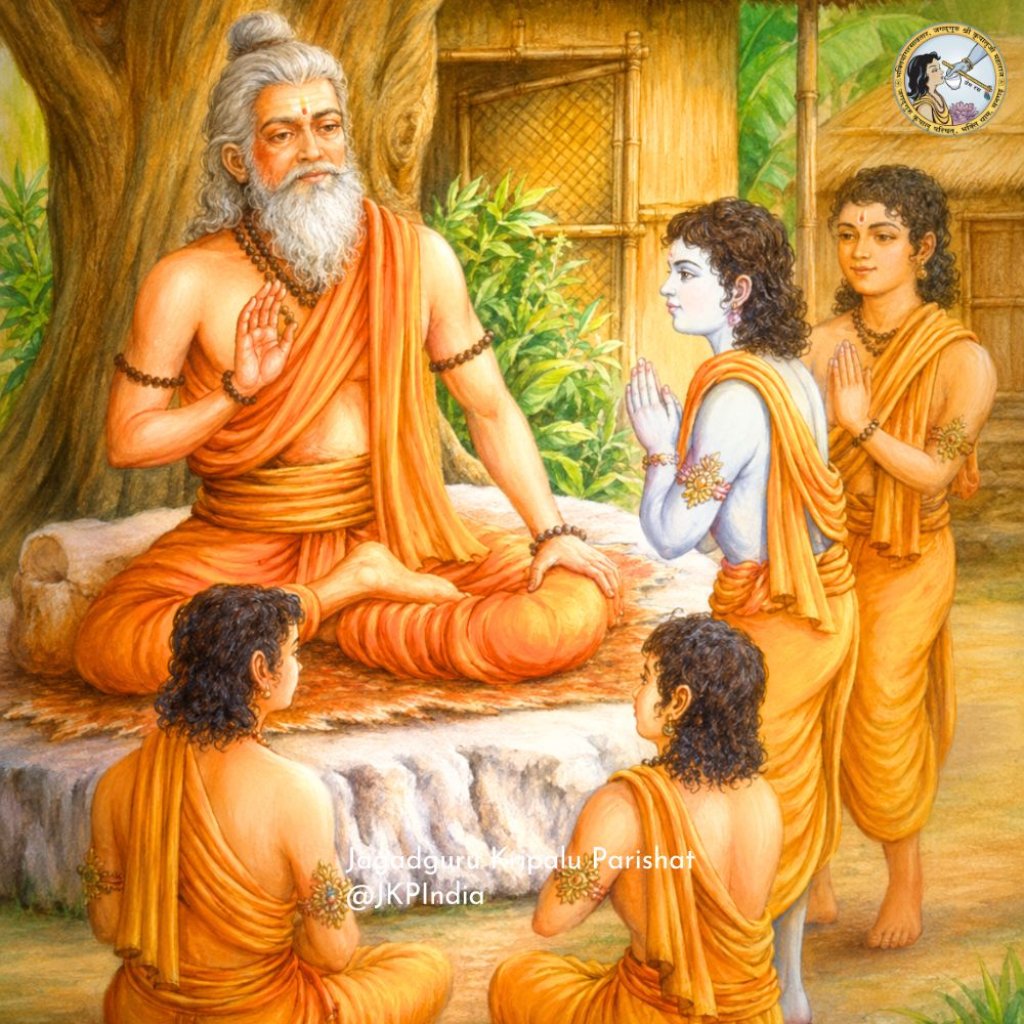
This is a question we must contemplate with the utmost seriousness. From the Vedas to the Ramayana, God and the Saints repeatedly declare that without the guidance of a true Guru, attaining Divine bliss, freedom from Maya, and life’s ultimate goal is impossible.
The Vedas describe only three fundamental Tattvas: God, the individual souls (jeev), and Maya. According to the Vedas, these three eternal realities are infinite and indestructible. Among them, the souls and Maya are the powers of God, while God alone is their Supreme Governor, Controller, Sustainer, and Inspirer.
Ved Vyas declares:
“There is no Divine existence equal to Guru Tattva.”
But what is Guru Tattva?
The Vedas speak of only three eternal realities – God, the individual soul, and Maya. So why is Guru Tattva referred to as the fourth existence?
Guru Tattva is called the fourth existence because the Guru is neither God, nor a soul bound by Maya, nor Maya itself. The Guru does not belong to any of these three categories. Rather, the Guru is Mayateet – beyond the influence of Maya.
The scriptures describe three distinct states in relation to Maya:
- Mayadheen – the individual souls who are under the control of Maya.
- Mayateet – the Guru or true Saint who has transcended Maya.
- Mayadheesh – God, the Supreme Controller of Maya.
Although each of these terms contains the word Maya, they represent three entirely different realities. The soul is bound by Maya, the Guru is beyond Maya, and God is the Controller of Maya.
Thus, the Guru occupies a unique and exalted position. He is beyond Maya, yet He is not the Supreme God. This is why Guru Tattva is spoken of as a distinct “fourth existence,” without whose guidance the soul cannot attain liberation or Divine bliss.
The soul (Mayadheen), while under the influence of Maya, wanders through countless births. But when that soul attains God (Mayadheesh), receives God’s Divine vision, and is blessed with His Grace, it becomes a Saint (Mayateet)—forever beyond the influence of Maya.
This is the true definition of a Saint.
A Saint does not become God, nor can he ever again come under the bondage of Maya. Once God-realisation is attained, he remains forever free from Maya.
Such a God-realised soul, who has transcended Maya, is called a Guru.
That is the true definition of a Guru.
There are many classes of Gurus. One class consists of those who have realised the impersonal (nirākār) aspect of God. Another consists of those who have realised His personal (sākār) form.
This truth has been clearly declared in the Vedas and affirmed by Adi Shankaracharya himself—that God is both formless and with form.
Accordingly, there are two broad categories of Gurus:
- The Guru who has attained the impersonal (nirākār) aspect of God.
- The Guru who has attained the personal (sākār) form of God.
Both have transcended Maya and are therefore true Gurus.
Within the second category, there are many further distinctions according to the particular form of God they have realised. For example:
- Maha Vishnu, the presiding deity of Vaikunth.
- Dwarikadhish Krishna, the Lord of Dwarika.
- Mathuradheesh Krishna, the Lord of Mathura.
- Vrindaban’s Shyām Sundar, the sweetest and most intimate manifestation of God.
These Gurus are further distinguished according to their bhāv (their devotional relationship with God):
- Dāsya bhāv — serving God as His servant.
- Sakhya bhāv — relating to God as His friend.
- Vātsalya bhāv — loving God as one’s child.
- Mādhurya bhāv — loving God as one’s Beloved.
Each succeeding bhāv represents a deeper and more intimate relationship with God than the previous one.
Even within Mādhurya bhāv, there are further gradations:
- Sādhāraṇī Rati
- Sāmāñjasya Rati
- Samartha Rati
Thus, there are many classes of Gurus, each according to the nature and depth of their Divine realisation. Yet, regardless of the particular aspect of God they have attained, they are all Gurus because they are all God-realised souls who have transcended Maya.
The word Guru itself is deeply meaningful. The syllable “Gu” signifies Maya, while “Ru” means the one who removes or dispels. Thus, a Guru is one who removes Maya from the heart of the soul.
A Saint who has realised the formless Brahman removes Maya, and likewise, a Saint who has realised the personal form of God also removes Maya. Both have transcended Maya, and both are Gurus.
What differs is not whether they are Gurus, but the Divine Bliss they have attained. The bliss of Divine Love (premānand) is immeasurably greater than the bliss of the formless Brahman (brahmānand). Even within premānand, there are countless gradations according to the intimacy of the devotee’s relationship with God.
Yet, regardless of the level of Bliss they experience, all God-realised Saints are Gurus because they are capable of removing Maya from the hearts of sincere seekers.
The Vedānt further proclaims that upon God-realisation, the soul experiences the very same Divine Bliss that God possesses. In terms of Divine joy, the liberated soul becomes equal to God. Thus, whatever Bliss God enjoys, the God-realised Saint also enjoys.
Between the words Saint and Guru, there is only one practical distinction. Every God-realised Saint is a Guru because every God-realised Saint is beyond Maya and capable of removing Maya. However, the Saint to whom we surrender, whose teachings we accept, and whose devotional path we follow becomes our Guru.
Imagine there are four God-realised Saints. All of them are beyond Maya, and all are Gurus. Yet the one to whom we surrender and from whom we receive spiritual guidance becomes our Guru. Although we continue to honour and respect the others, we do not establish the same spiritual relationship with them.
If one desires the love of the personal form of God, one has no spiritual relationship with a Guru who has attained only the impersonal Brahman. Similarly, we do not aspire to attain Krishna as the Lord of Vaikunth, Dwarika, or Mathura. Our longing is for Vrindaban’s Shyām Sundar, and therefore we surrender to the Guru who has attained Him.
The principle is really quite simple. Whatever aspect of God you desire to attain, seek a Guru who has attained that very aspect.
For example:
- If your goal is the formless Brahman, surrender to a Guru who has realised the formless Brahman.
- If your goal is the personal form of God, surrender to a Guru who has realised that personal form.
Whatever you wish to obtain, go to the shop that sells it.
Someone may ask, “If all are Gurus, what difference does it make to whom I follow?”
The answer is that indiscriminately following every Guru will only create confusion.
Suppose you first approach one Guru and hear, “I am extremely sinful. I am merely the servant of God.” Later, you attend the discourse of another Guru, such as Shankaracharya, who teaches, “You are God. You are all-powerful, all-knowing, all-pervading. You are the eternal witness, the well-wisher of all, the omnipresent Self.”
Naturally, the seeker becomes confused. One teaching declares, “I am the servant of God,” while another proclaims, “I am God.” Although both teachers are Gurus, they are speaking from different spiritual realisations and guiding seekers toward different spiritual goals. Without understanding this, the mind becomes disturbed, faith begins to weaken, and doubt arises.
For this reason, once you have chosen your spiritual goal:
- Surrender to the Guru who has attained that goal.
- Practise devotion according to his guidance.
- Respect all other Gurus.
- Never develop negativity or criticism towards them.
- At the same time, avoid close association if their teachings are directed towards a different spiritual destination.
Maharajji beautifully illustrates this principle through a simple example.
Suppose you go to the market intending to buy a pair of sandals. The first shop you come across is a sweet shop. You do not stop and complain, “Why have you opened a sweet shop? I’m looking for sandals!” Instead, you simply continue walking. Next, you pass a cloth shop, and again, you walk on.
The shopkeeper would naturally say, “This shop is for those who want sweets or clothes. If you’re looking for sandals, continue ahead. There are shops for that too.”
In exactly the same way, every Guru serves seekers whose aspirations correspond to his own Divine realisation. Rather than becoming confused or critical, remain focused on your own goal and seek the Guru who can lead you directly to it. Simply move on without negativity or disrespect, for every path exists for those whose spiritual aim aligns with it.
This also reveals one of the unique glories of Sanātan Dharma. There is something in Sanātan Dharma for every deserving soul. Different seekers have different aspirations.
For example:
- Some seek heavenly pleasures and the celestial abodes.
- Some seek liberation from Maya.
- Some long for Divine Love and God-realisation.
The scriptures prescribe an appropriate path for each of these aspirations.
Maharajji illustrates this with a humorous example. Once, a drunkard asked a fakir, “Tell me, are there more people in God’s abode or in hell?” The fakir replied, “Very few attain God’s abode because very few sincerely remember Him. But hell is crowded.”
The drunkard laughed and said, “Then I’ll go to hell! It sounds much livelier!”
Everyone has different preferences. Even today, people know that alcohol damages the body, yet they continue to drink. They knowingly choose habits that lead to suffering because of attachment and weakness of mind. In the same way, one person may prefer worldly enjoyment, another heavenly pleasures, another liberation, and yet another Divine Love.
Such is the greatness of Sanātan Dharma that it provides a path for every sincere seeker according to his or her spiritual aspiration.
Now consider this from another perspective.
In Christianity, it is said that Jesus taught, “If someone slaps you, offer him the other cheek.” This is presented as the ideal of forgiveness and humility.
What is the ideal presented in our own scriptures?
When Bhrigu Rishi kicked Bhagwān Vishnu on the chest, Bhagwān did not say, “Please kick Me again on the other side.” Instead, with folded hands and filled with compassion, He said, “Your tender feet must be bruised. My chest is very hard. Please forgive Me.”
Such is the depth of humility and Divine Love revealed in our tradition.
Now reflect for a moment. How many people in this world are truly capable of living such an ideal? How many can genuinely offer the other cheek, or respond with such humility, compassion, and love?
In the same way, how many people are truly qualified to follow the path of jñān?
To even begin walking that path, one must first possess the four essential qualifications known as Sādhana Chatuṣṭaya Sampatti. Yet, not only in our country but perhaps among billions of people in the world, only a handful may possess these qualifications.
Let us consider a practical example.
Imagine you are sitting here listening to a spiritual discourse. Suddenly someone arrives with devastating news: “The roof of your house has collapsed. Both your husband and your child have died.”
What would happen?
Most people would immediately cry out, “Forget the discourse!” and rush home.
But if you truly possessed the qualifications of a jñānī, you would calmly say, “Go. I will attend to it later. At this moment, I am listening to this discourse.”
Such is the extraordinary level of detachment, mental stability, and one-pointedness required for the path of knowledge.
One must first become highly qualified even to understand teachings concerning the formless Brahman.
This once again demonstrates the greatness of our scriptures. Every path has been described, and every path is valid for those who are qualified to follow it. Yet whatever your chosen spiritual goal may be, you should surrender to the Saint who has attained that very goal and make him your Guru.
At the same time, avoid becoming closely associated with Saints whose teachings are directed towards a different spiritual destination. Such conflicting associations may gradually become bad company for your own spiritual progress.
One Saint may teach: “Remain humble.”
Another may declare: “You are God. Repeat, ‘Soham, Soham’ (I am He).”
Yet another may instruct: “Repeat, ‘Dāso’ham’ (I am God’s servant).”
And still another may teach: “Repeat, ‘Sadāso’ham.'”
Each Saint teaches according to his own Divine realisation.
But what is the ordinary soul to understand?
Even a great scholar cannot reconcile these seemingly contradictory teachings merely through intellectual study. The scriptures themselves appear to say one thing in one place and the opposite elsewhere.
Only the God-realised Saints possess the direct experience necessary to reconcile these apparent contradictions and reveal the deeper harmony underlying them.
Without the guidance of a Guru whose realisation corresponds to our own spiritual aspiration, confusion and doubt inevitably arise.
For this reason, the true meaning of Guru is beautifully simple.
The one who, according to our spiritual goal and our inner longing for devotion, can bestow Divine benefit to us – He is our GURU!
By Jagadguru Shri Kripalu Ji Maharaj
A brief introduction of Jagadguru Shri Kripalu Ji Maharaj*
(Known by His devotees as Shri Maharaj Ji)
The original title of Jagadguruttam (Greatest Spiritual Teacher of the World) was bestowed upon Shri Kripalu Ji Maharaj on January 14, 1957, by Kashi Vidvat Parishad (a council of 500 greatest scholars saints of India). He composed divine texts like Prem Ras Madira, Prem Ras Siddhant, and Radha Govind Geet to lead us on the right path of devotion. He also gave priceless monuments as gifts to the world which include Bhakti Mandir located in Bhakti Dham, Mangarh, Prem Mandir located in Vrindavan Dham, and Kirti Mandir located in Barsana Dham. Shri Maharaj Ji also built hospitals for the impoverished, the Jagadguru Kripalu Chikitsalaya in Vrindavan, Jagadguru Kripalu Chikitsalaya in Barsana, and another one in Pratapgarh. All three help millions of underprivileged to gain free access to medical care. His Kindergarten, School, and College for impoverished girls Jagadguru Kripalu Parishat Education is located in Kunda and provides completely free education. To stay updated with all the news and events of Jagadguru Kripalu Parishat, visit www.jkp.org.in/jkpwhatsapp.
Follow us on Social
Recent Posts
Vijayadashami: The Divine Leela of Bhagwan Ram
19 October 2026
Durga Navami: A Prayer for the Divine Love of the Gopis
19 October 2026
Shri Radha Rani: The Divine Beauty That Enchants Even Krishn...
14 September 2026
Shri Radha Rani and Shri Krishna: Not two but one Divine Ent...
14 September 2026
Radha Rani: Her Divine Appearance and Transcendental Form
14 September 2026
The Art of Surrender: How to Let Shri Krishna Take Care of Y...
1 September 2026
How to Meditate on Shri Krishna
30 August 2026
The Divine Appearance of Shri Krishna
23 August 2026

The True Spirit of Hariyali Teej
14 August 2026
Guru Purnima Special: Why does God send Gurus to this World?
14 August 2026
Guru Purnima Special: Who is Greater – Guru or God?
24 July 2026
Guru Purnima Special: How does one find a true Guru?
24 July 2026

What Do You Have to Be Proud Of?
26 June 2026
What can the world really give us?
12 June 2026
Free Will: Choosing between God and the World
29 May 2026
Engage the Mind and Senses in Devotion
21 May 2026
Training the Mind in Bhakti
30 April 2026
Who is More Important – Sita or Ram?
25 April 2026
Akshaya Tritiya: Its True Significance
20 April 2026
God Alone Is Mine
18 April 2026
Ram in Krishna, Krishna in Ram
28 March 2026
The True Spiritual Significance of Holi
5 March 2026
Gaurang Mahaprabhu: The Incarnation of Divine Love
5 March 2026
Mahashivratri -Understanding the Oneness of the Divine
14 February 2026

Beyond Valentine’s Day: The Divine Love of Gopi Prem
14 February 2026
Jagadguruttam’s Teachings: How to Practice Bhakti for Shri...
17 January 2026

Jagadguruttam’s Teachings: Where is True Happiness?
17 January 2026

Jagadguruttam’s Teachings: WHO AM I?
17 January 2026
The New Year: A Time for Reflection
2 January 2026

Tulsi and Shaligram Vivah
2 November 2025
Akshay Navami: Remembering Radha Rani’s Lotus Feet
31 October 2025
Gopashtami: When God Became a Cowherd
29 October 2025
The Story Behind the Worship of Giriraj Govardhan
22 October 2025
Sharad Purnima Special – Always Feel the Presence of G...
5 October 2025

10th Anniversary of Jagadguru Kripalu Chikitsalaya, Vrindava...
26 September 2025
Janmashatami Special – Why connect with Shri Krishna?
11 August 2025
Janmashatami Special – Who is Shri Krishna?
5 August 2025
Who is More Merciful – God or the Saint?
11 July 2025
Who is Lord Jagannath?
27 June 2025
True Yoga: A Union of Body, Mind and Soul
22 June 2025
Celebrating Father’s Day with God
13 June 2025
Shri Radha Rani – Our Eternal Mother
10 May 2025
Sita is Ram, Ram is Sita
5 May 2025
Hanuman Ji’s Unmatched Seva
12 April 2025
Beyond Colors: Prahlad’s Teachings & the Spiritual Si...
15 March 2025
Beyond Colours: Prahlad’s Teachings & the Spiritual S...
14 March 2025
Who is Gaurang Mahaprabhu?
13 March 2025
What Blessing Should One Ask from Bhagwan Shiva?
24 February 2025
Celebrating 13 Glorious Years of Prem Mandir
22 February 2025
Gopi Prem Day – A Celebration of Divine Love
14 February 2025

Where does the soul go after death?
26 January 2025
The Relationship between God and the Soul – (The Real ...
21 January 2025
The Relationship between God and the Soul (The True Meaning ...
18 January 2025
The Relationship between God and the Soul
3 January 2025
Celebration or Contemplation on New Year
31 December 2024
The Unconditional Grace of God and Mahapurush
22 December 2024
Spiritual Leaders of Vrindavan Unite in Unprecedented Suppor...
10 December 2024
An Icon of Selfless Service: Remembering Her Holiness Sushri...
30 November 2024
A Soulful Tribute from the Preachers of Jagadguru Shri Kripa...
30 November 2024
The Story Behind Tulsi Vivah
11 November 2024
The Significance of Akshay Navami
10 November 2024
Bhaiya Dooj Celebrations
3 November 2024
Govardhan Pooja
2 November 2024

The secret behind celebrating Dhanteras
26 October 2024
Essence of Karwa Chauth
19 October 2024
Sharat Purnima, The Crest Jewel of all Festivals
18 October 2024
What is Roopdhyan by Jagadguru Shri Kripalu Ji Maharaj
12 October 2024
How do we control our Anger?
26 September 2024
Shri Radha Rani: The Essence of Divine Love
5 September 2024
The Divine Prison of Shri Krishna
31 August 2024
How to Build a Personal Relationship with Lord Krishna
25 August 2024
How to celebrate Raksha Bandhan
19 August 2024
The Significance of Hariyali Teej
7 August 2024
Rama Naam Satya Hai
5 August 2024
How to Engage Your Mind in God
5 August 2024
The importance of a Guru in a devotee’s life
15 July 2024

True meaning of ‘Yoga’ (Yog)
21 June 2024
Shri Krishna, Our Real Father
15 June 2024


How to control the mind?
2 June 2024

True Happiness
2 June 2024

How Fortunate You Are
31 May 2024
Narasimha Jayanti
19 May 2024
Importance of Sita Navami
15 May 2024
Importance of Mother’s Day
13 May 2024
The Significance of Akshaya Tritiya
9 May 2024
Lord Ram is our only True Relative
3 April 2024
Shri Guru Dham, Bhakti Mandir – A Divine Resolve
27 March 2024
The Festival Holi
25 March 2024
Bhakti of Lord Shankar Ji
7 March 2024
12th Anniversary of Prem Mandir
6 March 2024
Gopi Prem
13 February 2024
A Tale of Shabari
22 January 2024
Guru Dispels Darkness
14 January 2024
GOD and GURU
14 January 2024
Jagadguruttam Shri Kripalu Ji Maharaj
14 January 2024
New Year Message by Jagadguru Shri Kripalu JI Maharaj
30 December 2023
The Supremacy of Divine Name ‘RADHE’
30 December 2023

Akshay Navami
21 November 2023
Significance of Govardhan Pooja
13 November 2023
The Significance of Diwali
9 November 2023
Meaning of Karwa Chauth
31 October 2023
Sharat Purnima has come once again…
27 October 2023
Sharat Purnima
27 October 2023

How to find true peace and happiness?
13 October 2023
What is my relationship with God?
13 October 2023
Who is Shri Radha?
21 September 2023
The Supremacy of the Divine Name, ‘RADHE’
19 September 2023
What is our relationship with Shri Krishna? Part 3
28 August 2023
What is our relationship with Shri Krishna? Part 2
28 August 2023
What is our relationship with Shri Krishna? Part 1
28 August 2023
The Significance of Naag Panchami
21 August 2023
The Profound Significance of Guru Purnima
30 June 2023
THE GURU
30 June 2023

Why do we have mood swings?
28 May 2023
Discovering the True Mother on Mother’s Day
12 May 2023
How do we become more tolerant?
4 January 2023
What is the root cause of poor Mental Health?
16 December 2022

How to Improve your Mental Health in 3 simple steps
9 December 2022
How to end suffering and increase our Atman Shakti?
8 December 2022
Shri Radha Rani: The Divine Beauty That Enchants Even Krishn...
19 October 2026